
A.I. or Artificial Intelligence is not new, in fact the idea of “thinking machines was conceptualized during the mid-20th century. In 1950, Alan Turing reframed the question “Can machines think?” with the imitation game (later called the Turing Test), laying a philosophical and operational foundation for machine intelligence.
Since then, computers and storage have become faster and cheaper paving the way for an A.I.revolution. A.I. is quickly being woven into the fabric of our daily lives, so it’s important to understand some key terms as these will help you to become more fluent in using this technology that will continue to evolve.
By the end of this article, you’ll be able to understand these terms and think of ways you can use AI in your business.
1. Artificial Intelligence
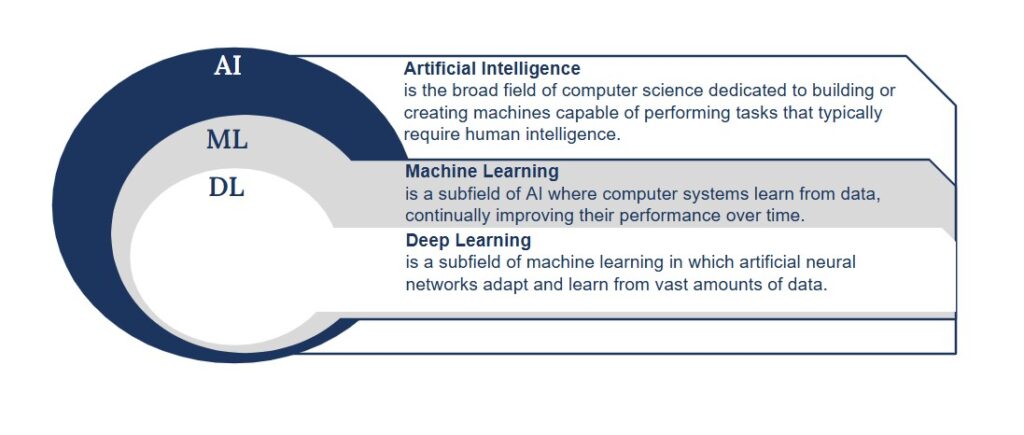
Artificial Intelligence is the broad field of computer science dedicated to building or creating machines capable of performing tasks that typically require human intelligence. These tasks include crucial human abilities such as learning, problem-solving, and decision-making. Fundamentally, AI systems rely on an AI model, which takes an input and generates an output based on its extensive training.
AI automates routine work and helps humans to make decisions from vast streams of data.
For example, in 2016 Google began using deep learning to power youtube video recommendations. A system like this operated by humans would’ve required a significant amount of time and money.
2. Machine Learning
Machine Learning (ML) is a specialized subfield of AI where computer systems learn from data to perform specific tasks, continually improving their performance over time. It operates without requiring explicit programming for every function, relying instead on algorithms to identify patterns in the data. The specific data utilized dictates the outcome, as different data sets are required to create models capable of solving different problems.
Machine learning is used to learn from data and improve over time, turning massive data and false positives (or errors) into accurate predictions at scale.
Have you ever received a text message or phone call to verify a purchase on your credit card? Have you ever checked your spam folder and found hundreds of emails that never reached your inbox? Those are examples of machine learning at work.
3. Deep Learning
Deep Learning (DL) is a specialized subset and specific technique within machine learning (ML). It is a specific way of teaching computers to learn from data by utilizing artificial neural networks. Deep learning techniques are the engine behind modern foundation models like ChatGPT, Microsoft Copilot or Google Gemini.
Deep learning learns directly from raw data and typically goes very “deep” on a topic so it’s predictions end up achieving state‑of‑the‑art accuracy. Deep learning is like a person who obtains decades of schooling in a matter of hours or days, they are very knowledgeable on a topic but without direct experience.
If you’ve ever relied on a weather forecast, for accurate data, deep learning may have helped you. For example, Google DeepMind’s delivers 10-day global forecasts in under a minute and outperforms many other existing weather prediction systems.
These first 3 are the most important terms to remember. These are the foundation for every other concept within the field of AI.
4. Large Language Models
Large Language Models (LLMs) are neural networks trained on massive text corpora to understand and generate human language, and in some cases to work with other models paired with vision/audio components. They learn patterns of grammar, knowledge, and style to perform tasks like answering questions, summarizing, and coding; many modern generative AI applications use LLMs directly or in combination with other model types.
LLMs turn natural language into a universal interface for software and knowledge work, enabling people to query, create, and automate using plain English (or any language). They also act as reasoning and coordination engines that can call tools, search, and take actions, amplifying productivity across tasks like writing, support, coding, and analysis.
Since 2022 LLMs have exploded in popularity powering applications like ChatGPT, Claude, & Gemini. For example, Gemini is integrated in Gmail and can help with automating email summaries and replies.
5. User Prompt
A user prompt is the text or instruction you give to an AI model to explain what you want it to do. It works as a guide for the AI model’s response. A user prompt can be a question, a task, or a request for content. A user prompt can also include context, examples, and constraints (tone, format, steps) to shape the model’s response. Clear and specific prompts usually produce more accurate and useful results.
Prompting is the most important aspect of using an AI Model to it’s full potential. Some prompting techniques work well with some models and poorly with others. There is no “one prompt fits all”
Prompting is like a map for a traveler…it doesn’t drive, but it decides where you end up.
Conclusion
Those are the top five AI terms every leader should know. With this vocabulary, you can frame opportunities, challenge assumptions, and de‑risk decisions. In our next article, we’ll unpack five more terms to help you evaluate vendors, brief your board, and set a responsible AI roadmap.
- Let's stay connected, Subscribe to our weekly newsletter.
- Need some help? Browse our curated directory of the best cloud applications.
